 New York, February 11, 2020 – Cysurance, LLC, a next-generation cyber insurance agency protecting small businesses and their partners through affordable cyber insurance, and Red Sky Alliance, a cyber threat intelligence firm delivering actionable data and analysis, today announced a new partnership to provide cyber risk management services to businesses. To read the full News Release follow the link.

Showing posts with label Wapack Labs. Show all posts
Showing posts with label Wapack Labs. Show all posts
Tuesday, February 11, 2020
CYSURANCE & RED SKY ALLIANCE TEAM UP TO DELIVER BUNDLED CYBER THREAT INTELLIGENCE & CYBER INSURANCE
New York, February 11, 2020 – Cysurance, LLC, a next-generation cyber insurance agency protecting small businesses and their partners through affordable cyber insurance, and Red Sky Alliance, a cyber threat intelligence firm delivering actionable data and analysis, today announced a new partnership to provide cyber risk management services to businesses. To read the full News Release follow the link.

Wednesday, June 28, 2017
Lurking Offshore: The Business Case Study for Working Together

Last week, the MPS-ISAO held a cybersecurity intelligence themed webinar, “Lurking Offshore: Active Cyber Threats Targeting Ports & Maritime”, with our partner, Wapack Labs. It’s a fascinating story about a financially motivated adversary using spear-phish to target Ports.I’m sure you are thinking, “Another scary cyber story… Why should I care?”By studying the data associated with this actor – how, when, why, and who, the case for Maritime and Port organizations working together to protect themselves from cyber adversaries is made. Cybersecurity silos need to be shattered - now.
Understanding the adversary.
Because Wapack has been tracking this adversary for some time, we have learned a lot by studying the intel.
First, this adversary is successful. Our intel team sees an almost 100% success rate with a low detection rate (< 5%) through traditional security technology and vendor sourced data. During the first six months of 2017, over 1,000 U.S. and European victims have been observed.
It’s a cost-effective, organized business operation. The malware being used only costs about $30 per month, and the adversary has developed a business model with specialized skills. Also, there is high reuse between victims. So, if one Port is compromised, there is a good possibility that other Ports will be targeted using the same spear-phish email.
And, this adversary is persistent. They improve odds of success by including supply chain partners in the scope of an attack. In one instance where a Port was the intended victim, ten suppliers to this Port were targeted at the same time and with the same spear-phish email being used across all organizations. The targeted suppliers were diverse too. They included organizations who performed:
- Construction Consortium
- Logistics Services
- Oil & Gas Services
- Consulting Services
- Marine Transport
- IT Services Provider
- Multi-Modal Transport
- Oil & Gas Engineering Services
Turning the tide.
In 2015, The Obama administration issued two important pieces of Cybersecurity legislation. A Presidential Executive Order (EO) was issued in February 2015 to promote private sector cybersecurity information sharing. Section 2 of this EO states, “strongly encourage the development and formation of Information Sharing and Analysis Organizations (ISAOs).” A few months later, the Cybersecurity Information Sharing Act of 2015 (CISA) was signed into law to “improve cybersecurity in the United States through enhanced sharing of information about cybersecurity threats.” CISA provides information sharing legal protections to organizations who participate in an ISAO.
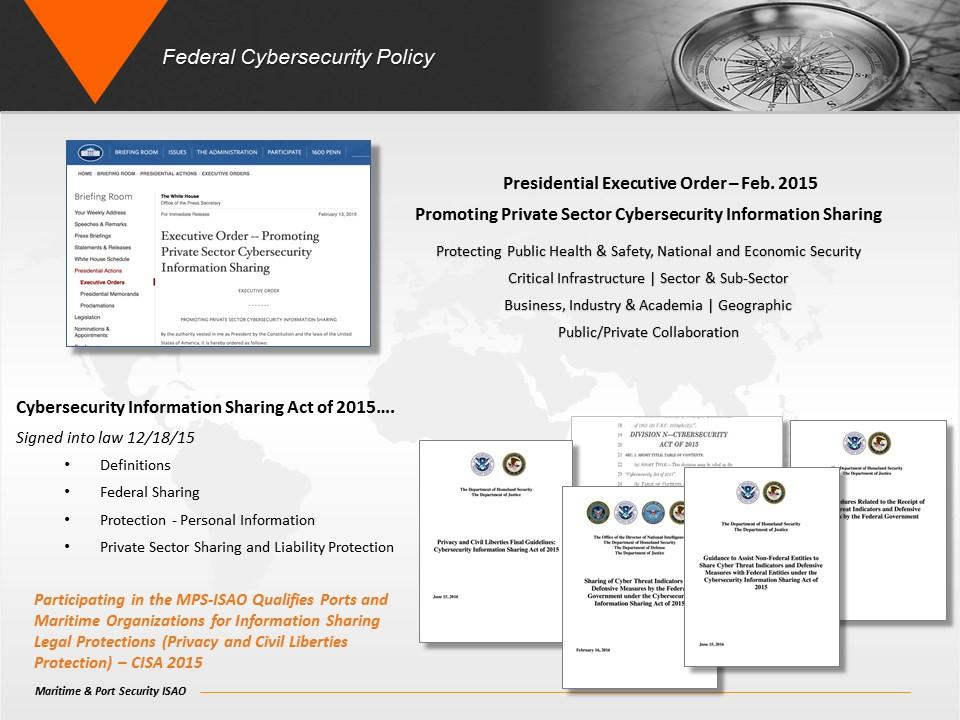
These two pieces of legislation led to the formation of the Maritime and Port Security ISAO, and its parent organization – the International Association of Certified ISAOs (IACI), to promote cyber resilience.
If someone could tell you where the sharks were, wouldn’t you want to know?
The MPS-ISAO, headquartered at the Global Situational Awareness Center (GSAC) at NASA/Kennedy Space Center, is a non-profit private sector-led organization working in collaboration with government to advance Port and Maritime cyber resilience. The core mission to enable and sustain a safe, secure and resilient Maritime and Port Critical Infrastructure through security situational intelligence, bi-directional information sharing, coordinated response, and best practice adoption supported by role-based education.
Port and Maritime organizations who subscribe to the MPS-ISAO’s cyber intelligence service have the advantage of early threat awareness provided via industry-specific, cross-sector, and global cyber intelligence along with countermeasure solutions. They participate in a Maritime and Port community composed of stakeholders from across the industry sector who are interested in working together to achieve cyber resilience.
Going back to the Lurking Offshore Case Study, we know that this adversary targets multiple victims within a Port’s supply chain using the same malicious email, and then reuses the email across another 8-10 Port victims. When the email is shared into the MPS-ISAO Community, early threat awareness enables organizations to put protective measures in place.
So, a single share can protect many.
And, the business case for working together was never stronger.
Wapack Labs’ engineers, researchers, and analysts design and deliver transformational cyber-security analysis tools that fuse open source and proprietary information, using deep analysis techniques and visualization. Information derived from these tools and techniques serve as the foundation of Wapack Labs’ information reporting to the cyber-security teams of its customers and industry partners located around the world.
Tuesday, October 11, 2016
Wapack Labs Teams with the VAMC, Southern NH University and Digimind to Re-Train Returning Veterans into Next Generation Cyber Pros
New Boston, New Hampshire, October 10, 2016
Wapack Labs, Digimind, Southern New Hampshire University, and the Veterans Administration Medical Center (VAMC) in Manchester, NH team up to turn returning veterans into qualified cyber professionals.
There are roughly 290,000 currently advertised information security jobs today and while the number of training programs is growing, Wapack Labs believes that not everyone needs a four-year degree to fill the void. So we offer paid internships through Manchester’s VAMC Occupational Therapy office for honorably discharged or medically retired returning veterans, and experiential learning internships for Southern NH University veteran students. We begin their program by teaching them to use Digimind social media tools to spot physical threats in cyberspace. The vets are taught to be cyber analysts through a series of increasingly more complex cyber skills reinforced through work. The entire program takes approximately a year.
When the veteran interns meet Cyber Analyst requirements, Wapack Labs has several Fortune 500 companies and government organizations who have agreed to interview them for available positions.
Veteran interns used Digimind tools to support the Cleveland Police Department’s efforts before, and during the Republican National Convention, major sponsors onsite at the Rio Olympics and the team “Team Jaeger” has authored roughly 150 intelligence reports since inception in May.
Wapack Labs is using Digimind’s services to train cyber analysts with real time sourced data.
Jeff Stutzman, CEO and a U.S. Navy veteran stated, “At Wapack Labs, we are proud to help these guys learn cyber skills that will place them in an ever growing industry. The majority of our employees are US Military veterans and National Guard members. We feel it is of the utmost importance to help our veterans.”
"Digimind is proud to be a part of this effort by Wapack Labs to train and employ veterans. Beyond the clear benefit to the veterans as individuals, the fact that this software is being to used to keep citizens of multiple countries more secure is an additional boon. Digimind hopes to continue to partner with Wapack Labs, contribute to this program, and be a part of similar programs in the future." said Paul Vivant, CEO of Digimind.
The common sense approach and wide array of metrics regarding social media collection offered by Digimind has proven very valuable to Wapack Lab’s collection mission. Digimind was instrumental in Wapack Lab’s support of law enforcement collection efforts during the 2016 Republican National Convention in Cleveland OH. Following the RNC, Digimind services were used in a collection program in support of the 2016 Summer Olympics in Rio de Janeiro, Brazil. Training new analysts using Digimind’s “Influencer” metrics has helped Wapack Lab’s interns identify social media individuals in active support of event security planning and with targeting potential bad actors and their attacks against Wapack Labs clients.
About Wapack Labs
Wapack Labs, located in New Boston, NH is a Cyber Threat Analysis and Intelligence organization supporting the Red Sky Alliance, the FS-ISAC, and individual organizations by offering expert level targeted intelligence analysis answering some of the hardest questions in Cyber. Wapack Labs' engineers, researchers, and analysts design and deliver transformational cyber-security analysis tools that fuse open source and proprietary information, using deep analysis techniques and visualization. Information derived from these tools and techniques serve as the foundation of Wapack Labs' information reporting to the cyber-security teams of its customers and industry partners located around the world.
About Digimind
Digimind is the global social media monitoring and competitive intelligence company that provides businesses with unrivaled insights into their true standing in the market. Digimind's proven intelligence technology has provided Fortune 500 brands around the world with critical information for their business for more than 17 years. Profitable since its founding, Digimind has a 92 percent customer retention rate and serves its clients out of its offices in North America, Europe, Asia and Africa. For more information, please visit Digimind at www.digimind.com.
For questions or comments regarding this news release, please contact Jim McKee, CFO at 314-422-8185 or jmckee@wapacklabs.com.
Wapack Labs, Digimind, Southern New Hampshire University, and the Veterans Administration Medical Center (VAMC) in Manchester, NH team up to turn returning veterans into qualified cyber professionals.
There are roughly 290,000 currently advertised information security jobs today and while the number of training programs is growing, Wapack Labs believes that not everyone needs a four-year degree to fill the void. So we offer paid internships through Manchester’s VAMC Occupational Therapy office for honorably discharged or medically retired returning veterans, and experiential learning internships for Southern NH University veteran students. We begin their program by teaching them to use Digimind social media tools to spot physical threats in cyberspace. The vets are taught to be cyber analysts through a series of increasingly more complex cyber skills reinforced through work. The entire program takes approximately a year.
When the veteran interns meet Cyber Analyst requirements, Wapack Labs has several Fortune 500 companies and government organizations who have agreed to interview them for available positions.
Veteran interns used Digimind tools to support the Cleveland Police Department’s efforts before, and during the Republican National Convention, major sponsors onsite at the Rio Olympics and the team “Team Jaeger” has authored roughly 150 intelligence reports since inception in May.
Wapack Labs is using Digimind’s services to train cyber analysts with real time sourced data.
Jeff Stutzman, CEO and a U.S. Navy veteran stated, “At Wapack Labs, we are proud to help these guys learn cyber skills that will place them in an ever growing industry. The majority of our employees are US Military veterans and National Guard members. We feel it is of the utmost importance to help our veterans.”
"Digimind is proud to be a part of this effort by Wapack Labs to train and employ veterans. Beyond the clear benefit to the veterans as individuals, the fact that this software is being to used to keep citizens of multiple countries more secure is an additional boon. Digimind hopes to continue to partner with Wapack Labs, contribute to this program, and be a part of similar programs in the future." said Paul Vivant, CEO of Digimind.
The common sense approach and wide array of metrics regarding social media collection offered by Digimind has proven very valuable to Wapack Lab’s collection mission. Digimind was instrumental in Wapack Lab’s support of law enforcement collection efforts during the 2016 Republican National Convention in Cleveland OH. Following the RNC, Digimind services were used in a collection program in support of the 2016 Summer Olympics in Rio de Janeiro, Brazil. Training new analysts using Digimind’s “Influencer” metrics has helped Wapack Lab’s interns identify social media individuals in active support of event security planning and with targeting potential bad actors and their attacks against Wapack Labs clients.
About Wapack Labs
Wapack Labs, located in New Boston, NH is a Cyber Threat Analysis and Intelligence organization supporting the Red Sky Alliance, the FS-ISAC, and individual organizations by offering expert level targeted intelligence analysis answering some of the hardest questions in Cyber. Wapack Labs' engineers, researchers, and analysts design and deliver transformational cyber-security analysis tools that fuse open source and proprietary information, using deep analysis techniques and visualization. Information derived from these tools and techniques serve as the foundation of Wapack Labs' information reporting to the cyber-security teams of its customers and industry partners located around the world.
About Digimind
Digimind is the global social media monitoring and competitive intelligence company that provides businesses with unrivaled insights into their true standing in the market. Digimind's proven intelligence technology has provided Fortune 500 brands around the world with critical information for their business for more than 17 years. Profitable since its founding, Digimind has a 92 percent customer retention rate and serves its clients out of its offices in North America, Europe, Asia and Africa. For more information, please visit Digimind at www.digimind.com.
For questions or comments regarding this news release, please contact Jim McKee, CFO at 314-422-8185 or jmckee@wapacklabs.com.
Saturday, October 1, 2016
Cyberwatch update
 To all who've been using Cyberwatch(R) and provided feedback, thank you! It's very much appreciated. As a result of some of these feedback, Cyberwatch API version 1.1 was released last night, and its packed with improvements that you've requested:
- 25-35% faster with database clustering improvements
- For our automated alerting mechanism, we've built in dynamic notification API keys, which don’t require authenticating! Click through, see everything we know from that
- API key removal from the url on the front end wrapper
- Security Updates & bug improvements
To all who've not yet heard of Cyberwatch, last week we went public with a new application program interface (API), that allows users to run queries against our backend raw intelligence collections. We knew two things...
First, many (all?) companies need intelligence --not just information received when they buy that million dollar security tool, but a real understanding of what's going on outside of their border router that will likely affect them.
Second, many of those companies would prefer to slog through the myriad of google groups, open source lists, and take on the dark web themselves and waste an enormous amount of time chasing things that just don't mean much to the questions they should be asking themselves.
For example... a RISK focused security pro will always want to know if there's a RISK of something breaching. And if they do, what's the likelihood of loss?
An INTELLIGENCE focused security pro will want to look over the horizon for risks that'll might mean something soon, or they'll want to know that tactical information --what IP blocks should we be monitoring now? Blocking now? Remediating?
At the same time, our customer base is largely 100,000 computers or bigger... which while good for us, represents a small number of companies who need help... and who may be partnered with or in the supply chain to these larger companies.
I've talked with dozens of smaller companies. They simply can not, and like will never, spend the money on an intelligence shop.
So what if Wapack Labs could help them? What if we could allow users to query our backend data for say, 30 queries per day (for free), so that these smaller companies could see exactly what they're exposure looks like --and what if Wapack Labs could refer them to a security professional (under NDA of course) to help that smaller company get well?
Well, that's exactly what we did.
- Wapack Labs passively collects key logger 'dump' locations at about 1300 locations around the world;
- We collect on very specific sinkholes;
- We collect some specific open source --but not all... we don't want circular reporting;
- And we collect about a dozen other specific items that can help tell a company when they might have problems.
And we make that all searchable to anyone who wants to search against it.
As well, we started (this week) performing automated victim notifications. Our first batch, roughly 5000 of them, went out on Wednesday, with a no-cost, one time link to our databases to show the companies what we found, and why we think they may have been victimized. That email contains a link to our new Partner Exchange Program, and allows the victim to request a referral to one of our trusted, NDA'd, partners who can assist in the cleanup if needed.
The Cyberwatch API is available at api.wapacklabs.com.
Need more? We've built an ugly demo front end (we'll make it look nicer soon, I promise) on the API... cyberwatch.wapacklabs.com. Use it to monitor a portfolio of companies. If you're watching your supply chain, or a group of investment companies, you can set up five companies in our Cyberwatch front end, or you can use the API to bring the data into your own environment. Either way... you should be able to pull our data into a usable front end of your choosing or use ours.
So, to those who've provided feedback? We're listening.
To those who've not yet tried it? Try it!
We're heading into Christmas shopping season. And although much of the work we'd done in the past is APT and Espionage related, we've taken on a second flavor in our analysis --money. So if you're a retailer, financial institution, or a supplier to one of these, as we head into the Christmas shopping season you should be watching our API at least daily, knocking down the threats we identify.
Give it a try. There's absolutely no reason you shouldn't... it's free and we might know something about you that you don't already know.
Until next time,
Have a great weekend!
Jeff
(CyberWatch(R) is a registered Trademark of Wapack Labs Corporation.)
Monday, September 12, 2016
Wapack Labs Announces Cyberwatch® API for Proactive Cyber Threat Intelligence.

Orlando, FL, September 12, 2016: Wapack Labs, a cyber threat intelligence company, announced their new Cyberwatch® Application Program Interface (API) today at the Information Security Certification Consortium (ISC2) Congress in Orlando, FL. Companies will now be able to search Wapack Labs’ cyber intelligence collections directly through this bold, new application. That means users can identify and address security threats faster—including before they’re realized.
Wapack Labs recovers information stolen by hackers from keylogger information, sinkholes, the dark web, malicious emails, and more. “With Cyberwatch® API, we’re opening our collections to those not normally privy to high-end cyber threat intelligence,” says Jeff Stutzman, CEO of Wapack Labs. Everything from usernames and passwords to financial transactions and credit card information can indicate previously unknown network breaches. Users can simply enter a company domain into Wapack Labs Cyberwatch® API (api.wapacklabs.com) and find out if it has been compromised.
What makes Wapack Labs Cyberwatch® API of even greater value, however, is that it enables companies to be proactive. “Because of the sheer volume of our backend collections—which also includes data derived from malicious actors’ activities, and not just the information they steal—results from your search can help you identify if you’re being targeted.” Stutzman explains. This is revolutionary for an industry where, today, offerings are almost always post-hoc; that is, they are built after a company has already been broken into. Antivirus, sharing intrusion prevention rules, and indicators of compromise all rely on expert analysis after someone has been hacked, and damage is already done. For another company to successfully capitalize on these types of security offerings, they must obtain and incorporate this information into their security tools before the threat evolves.
The Cyberwatch® API enables companies to connect their security tools directly to Wapack Labs’ intelligence backend, giving them direct access to clean, parsed data without requiring additional analysis, thereby prioritizing work for CISOs and their cyber security operations center (SOC) teams.
“These are not credential dumps or aggregated data,” says Stutzman. “This is information stolen by nefarious actors or malware from roughly 15,000 companies and organizations all over the world. If a company or individual finds themselves in a query of our data, if they haven’t been hacked yet, they may be soon, and can get a head-start on precautions.”
Wapack Labs, located in New Boston, NH is a Cyber Threat Analysis and Intelligence organization supporting the Red Sky Alliance, the FS-ISAC, and individual organizations by offering expert level targeted intelligence analysis answering some of the hardest questions in Cyber. Wapack Labs’ engineers, researchers, and analysts design and deliver transformational cyber-security analysis tools that fuse open source and proprietary information, using deep analysis techniques and visualization. Information derived from these tools and techniques serve as the foundation of Wapack Labs’ information reporting to the cyber-security teams of its customers and industry partners located around the world.
For questions or comments regarding this report, please contact the lab directly by at 603-606-1246, or Chuck Nettleship at cnettleship@wapacklabs.com.
Monday, September 2, 2013
The Pocket Sized Attack

Back in July Reuters reported on warnings by a UN team regarding mobile device vulnerabilities.
Last week, I got an email notice from the Facebook gods that once again their policies were changing, among them some updates to language concerning what data you're sharing with mobile devices.
4 days prior to that, I saw this article in the New York Times about malicious software being installed by clicking on a video link.
And immediately prior to that, Red Sky and Wapack Labs came out with a Priority Incident Report in which it was stated:
"Kaspersky recently reported that five million Android devices have been infected with malware, through Google Cloud Messaging, which allows hackers to send update messages directly to applications installed on a device.[i] The malware is designed to steal the victims information including the phone’s contact list and is the most diffused agent in over 97 countries."
As I mentioned previously, one of the most common vectors that bad people use to get into the intellectual property of companies large and small is through you and your contacts.
Being able to hijack a contact list allows hackers to gain a treasure trove of information that otherwise would take multiple phishing attacks over long periods of time. Names, addresses, phone numbers, company info...all of which can be used in very specific social engineering.
I'm delivering a presentation in a few weeks to a group of concerned parents that are exactly the same as every other parent. They are concerned about their children and want to do everything they can to protect them. What makes this group intriguing is that they have extremely high net worth.
Does this make them any different than you and me? Not in the least.
Hackers will use any vector they can to get the information that they need. High net worth individuals tend to be in CXO type positions or have significant influence in their companies. If their children are not using safe online practices, it could expose the parent to attacks both physical and cyber.
These days, most parents will have their children listed as contacts and vice-versa (at least one would *think*). To the hacker, it's all about who is in your contact list and how that information can be exploited. They have no problem compromising a child's mobile device to gain access to home networks of powerful people.
For some reason, the folks that I speak to tend to believe that cyber attacks will only occur on their laptop or home computer or company network. They forget that the device that they hold in their hand is a 4 ounce key to their entire life, sometimes much more powerful and valuable than anything you may have on your daily PC.
Just because you can fit it in your pocket doesn't mean it is any less susceptible to compromise.
Stay vigilant, stay up to date with your security patches, and for goodness sake, don't click that sketchy Facebook video link on your phone.
Friday, August 23, 2013
Airports and APTs

I'm sitting here at Logan Airport waiting for a flight. Like a lot of folks, I am a people watcher. As the crowds float by, I am fascinated by human interactions. What I tend to notice more often than not is the complete and utter lack of personal security most adults display.
Humans by nature are very trusting individuals, and this is the crux of the problem, especially to those of us in the world of security.
Society dictates that we be polite to one another, and it is a common belief that in general people are not out to do us harm.
This statement, although primarily true, has a weakness: there are always people willing to do us harm. The Media makes a living off of reporting it.
As folks stand in line, I am often amazed by the amount of information that they give out: where they are going, who they are meeting, if they are alone, where they are from, what they do for a living, and on and on. This information, in the hands of a malicious person can be an entry point into your personal and professional data. If we are willing to give up our personal security to complete strangers at an airport, how can it be expected that we make a paradigm shift as a culture towards cyber security? How do we make people more vigilant in their ever increasing dependence on current technology?
Hold that thought.
So as I sit here in the terminal, I'm also reflecting on the notion of short term vs long term "pain". The website Hackmageddon lists current cyber security threats and there is always some interesting analysis to be found. For example, 57% of the cyber crime perpetrated last month is general financial theft, fraud, and the like. Only 4% of crimes in the previous month are the Advanced Persistent Threats: highly targeted industrial espionage attacks. This is where intellectual property of high profile companies is stolen, resulting is significant and negative financial impacts.
What kinds of intellectual property? How about the plans for your next phone or your next network-connected television or the control systems of your car?
If you're more concerned about the 57% than the 4%, then we have some work to do. The short term cyber crime (credit card theft, etc) is painful for the individual. There is no doubt about that. However, losing the intellectual property that is driving this country's future innovation is hurting all of us at once and will lead to longer term national impacts.
So how does this all tie together?
Typically, hackers will use exploits in general human interactions and security practices to gain access to the networks that drive our companies.
Maintaining proper security practices is vital to keeping us all safe. If you're new to security and are reading this blog, you are well ahead of most individuals. One of the best ways to learn more is to actively engage with other people passionate about the same topics. That's what we do every day at Wapack Labs in the Beadwindow™ portal. Get in touch with us and join the conversations.
Friday, August 9, 2013
Silence Ain't Golden

I'm a gun guy.
I shoot frequently, I attend as much training as I can, I research gear incessantly, and I am constantly staying up to date on what is "best of breed" in the industry. I network with folks to get news on trends and understand why a product does or does not work. This social connection is the single most important influence in my purchasing.
I read books on tactics, mindset, preparedness, and avoiding violence in the hopes of one day being able to use that knowledge to help myself and those around me should I ever be in a situation where it is needed.
I owned a small profitable business. I am very active in social media. I have many terabytes of information stored across disk arrays in my house that make my electricity provider very happy.
I spent MANY years at a top networking company in the IT organization.
I own a big dog.
Nutshell, I take my environment and situational awareness very seriously.
Why is it then that until recently, I did not take the same precautions with my digital security?
Why? Because when I step away from my keyboard, I don't see anyone in my environment that can physically harm my equipment. And this is bad.
As a small business owner, I rely on my systems to work when I need them. I do not want to find myself in the Ron Burgandy-type situation of saying that "60% of the time, my credit card processing works every time"
I also do not want to leave myself open to unknown threats.
Now more than ever, SMBs are hosting their websites, card processing, customer data, and financials out in the cloud. Often times, these systems are secure at the individual account level, but what about the host themselves? Are they not subject to attack? Do you know the ins and outs of their disaster recovery or intrusion prevention strategies? No? How does that make you feel?
Let's suppose you are a brick and mortar retail owner that runs Quickbooks on their personal laptop in the office, and then goes home or to a coffee shop and surfs the web and checks email? You happen to unknowingly install malware. This vicious little bit of code then contacts a Command and Control server (CNC) and alerts the hacker that info is ready for the taking. From that point, you, your financials, and your customer data are compromised. Depending on the sophistication, your machine can then be used to penetrate others.
Point is, most small companies or individual businesses do not spend enough time considering the implications of the security of their data environment. They expect that their backups are being backed up by some geek in a closet, and if something goes wrong, they just get restored and running without a hitch. Unfortunately, most of us learn the hard way that this is far from reality.
As business owners, we host with companies that are recommended by friends. We use products recommended by peers. We read Amazon reviews religiously. Why is it then that we don't use the same peer group style of interaction to maintain vigilance over our digital world? Because we don't want anyone knowing our business.
This is where I have changed my point of view. As a life long student, I find that the best way to learn is to talk to the folks that have been there and done that. The people that are experts in their fields and are more than willing to give me advice to spare me pain. Freeing myself of my own ego in this regard has allowed me to learn more than I ever imagined.
The moral of the story:
As individuals, we spend an infinite amount of time and energy preparing ourselves for physical situations, but rarely apply the same consideration to our digital lives. We're afraid to reach out for help or talk to others for fear of appearing weak.
It's time to change that mindset. This isn't about being weak. It's about becoming strong. Take a look at what is going on over in Beadwindow® at Wapack Labs. These are the experts that can help and they are doing it by the best way we as humans know how: by talking to each other.
Join our conversations.
Wednesday, July 3, 2013
The Secret Lives of Computers
The Secret Lives of Computers:
The things you find in a digital forensic investigation

It is often asked “Why would I ever conduct a forensic
investigation on a computer?!” Well if you are concerned about what people are
doing on a computer (or cell phone), what is going on it, coming from it, or
happening to it then it benefits you to conduct an investigation. A digital
forensic investigation sounds like a big complicated procedure, but an initial
examination can have a relatively quick turn around and give you plenty of
information. In some cases involving white collar crime, a single investigation
(with an affidavit) can be brought to civil court to produce injunctive relief
or even settlements.
So let's begin to answer the mysteries of a computer
investigation and see if it is something that would benefit you, your company,
or legal situation. In a preliminary forensic investigation many questions can
be answered if you are concerned about something specific, but typically we like to
try and shed light on the following:
File Activity
No, unfortunately I can't show you files jumping around or
being active, but I can show you creation, deletion, and modification. In most
cases this file activity drives the rest of the investigation. When we plot out
file activity on a timeline it begins to tell a tale of what was going on with
the computer at the time. For instance if we see large file creation on a
certain date, then that usually indicates things like installing programs or
copying files from one place to another. If we see a lot of file deletion, then
that could mean that someone is trying to “burn” or “shred” the evidence. If
you couple large creation and deletion together then that could point to
someone copying files from one place (let’s say your company’s network server)
to the local system, copying off the computer (maybe to a thumb drive) and then
wiping them clean. Or so they think.
USB Drives
USB devices are becoming more ubiquitous and increasing to
incredibly large capacities. The amount of data that used to be contained in
several servers is now placed onto one 2TB external hard drive. While their
capacity is very large, their physical size gets smaller and smaller. Are you
aware of all the things that your employees are carrying on a thumb drive? Very
few companies implement a policy to control the flow of information to external
devices. In my experience, a majority of my investigations have included
someone plugging a thumb drive into their computer days, if not hours before
they leave the company. Are you sure they only took their personal photos and
music, or did they just clean out all of your client records and proprietary
information?
Internet History
Internet history can sometimes be the most telling of all
the information in a computer. How often do you go to work, log into your
computer, and then go directly to Gmail and log into your personal email? Few
companies restrict this type of personal access (although they may frown upon
it). Today many applications and services are becoming “cloud ready”. This
means that information is no longer stored on your local systems. Instead this
information travels out over the Internet and is stored on some other company’s
servers. Is it secure in travel? Is it safe when sitting on those servers? Many
services like Dropbox also offer huge amounts of storage space for people to
upload information to. An employee could easily upload information from their
system, to Dropbox, and then access it from anywhere else in the world.
If you aren’t concerned about movement of data through the
Internet, maybe you are concerned about what your employees are doing on their
computers as far as spending too much time on Facebook or playing games. Plenty
of HR people lose sleep over what is being done and said over things like
Facebook or Instant Messaging. In many cases a computer investigation can
collect and parse this type of information and even give you remnants of the
pages that the person looked at. For investigations pertaining to harassment,
chat logs can be collected and produced for legal counsel (in many cases even
if they had been deleted).
Wait, there’s more…
These are just a few of the things that a standard
preliminary investigation could offer you. If you have a concern about what is
happening on your work or personal computers, then please give Wapack Labs a
call to find out how we can help. Whether you are in HR, legal, IT, or own your
own business, there are several ways that we could help put your mind at ease
or solidify a legal action. Our certified and experienced digital forensic
examiners can assist with almost any type of digital investigation. We
specialize in helping even those that have never heard of digital forensics or
are wary of technology in general. Don’t worry, we speak English too and won’t
get overly technical! Wapack Labs is located in Manchester, NH and services all
of New England. Call us at 603-606-1246, email me at dkirmes@wapacklabs.com, or stop by our lab at 250 Commercial
St. Suite 2013.
Friday, June 21, 2013
Info. Security: Do you have the right people for the job?
Information Security:
Do
you have the right people for the job?
When you have a problem at your house (or are building a new
one), do you trust your general contractor to do the specialized and
sophisticated work? If your pipes burst, don’t you want a licensed and
experienced plumber to take care of it? If you choose a dedicated and
specialized professional for these jobs, why aren’t you doing the same thing
with your IT security? Why trust the same guy that plugs in your printers and
keyboards with sophisticated work like managing your network security,
protecting you against targeted attacks, and preventing your client and private
information from being stolen?
In today’s digital landscape hackers are becoming more
sophisticated and precise in their attacks. These attacks come from all corners
of the internet: from China looking to steal proprietary intellectual property,
from Iran looking to disrupt bank transfers, and from “hacktivists” like
Anonymous and other groups. How can you depend on your IT group (either in
house or consultant) to know and defend against all of these online threats?
The reality is that you can’t. When it comes to information security, you need
someone that has seen the threats first hand and knows how to protect against
them.
Here at Wapack Labs we have experts with proven track
records in the field. Our analysts and digital forensic examiners have years of
real world experience protecting companies large and small from targeted and
complicated attacks to their information networks. Backed by the power of its parent company Red
Sky Alliance, Wapack Labs is able to bring the knowledge and information
sharing of Fortune 500 companies to the table to protect your network.

We know how to protect you and your data, and we have
developed a layered solution that will make sure that you are secure from every
angle. Here at Wapack Labs, we have developed the Socrates Solution (our own
version of the Socratic
Method). This solution combines information security protection from
industry leaders into an easy to install solution that we manage for you! The
impact to your company is minimal and you don’t need to train your current
staff to operate or manage the equipment. Once a simple setup is done,
everything is managed off site from our location in Manchester, NH. The Socrates
Solution protects against threats from the outside at the perimeter (right
where your modem is) all the way down to the individual workstation. If your
business needs to conform to HIPAA, PCI, or Sarbanes–Oxley regulations then the
Socrates Solution is for you and can give you Data Loss Prevention (DLP) to
make sure that none of your personal and client information is getting out.
If you are concerned about your current security setup, or
just have questions as to how we can help you, don’t hesitate to give us a call
at 603-606-1246 or email me at dkirmes@wapacklabs.com
Subscribe to:
Posts (Atom)